AI Integration Roadmap: A Guide for Non-Technical Founders
By VORTEXA Engineering Team ·
"We need AI in our product" is one of the most common requests we hear from founders — and one of the least useful starting points. AI integration only pays off when it's tied to a specific, measurable problem.
Start with the problem, not the technology
Before any technical work begins, we ask founders to answer one question precisely: what decision or task currently takes a human too long, or is too inconsistent, that AI could meaningfully improve?
- Customer support triage and response drafting
- Document/data extraction from unstructured formats
- Predictive analytics on existing operational data
- Personalization and recommendation logic
Realistic timelines
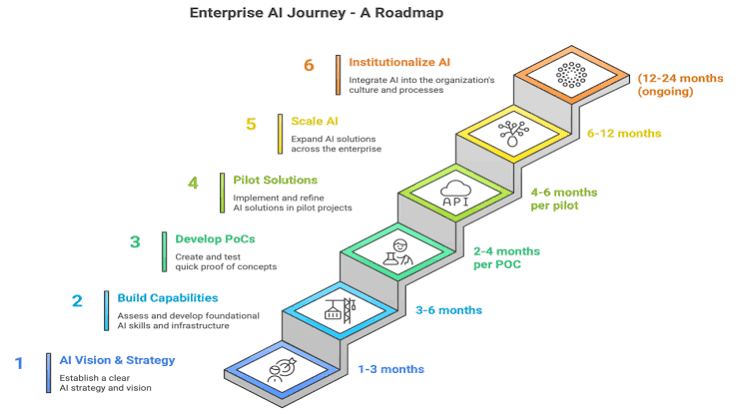
A focused AI feature (e.g. an intelligent support triage system) typically takes 6-10 weeks from discovery to production, assuming clean existing data. Broader AI platforms with custom model training can take 4-6 months.
What actually costs money
Model API costs (OpenAI, Anthropic, etc.) are usually a small fraction of the total budget. The real cost is in data preparation, integration engineering, and building the guardrails that keep AI outputs safe and on-brand.
Common pitfalls
The most frequent mistake is skipping a small pilot and committing to a large AI rebuild upfront. We recommend shipping a narrow, well-scoped AI feature first, measuring its real-world impact, and expanding only once the ROI is proven.
Where to go next
For a deeper look at what these projects include and how to evaluate a partner, read our guide to AI development services for businesses, or explore our AI development services.
Frequently asked questions
How long does it take to add AI to a product?
A focused feature such as support triage typically takes 6-10 weeks from discovery to production with clean data. Broader platforms with custom model training can take 4-6 months.
How much does AI integration cost?
It depends on scope. Model API fees are usually a small share of the budget. Most of the cost goes into data preparation, integration engineering, and guardrails. Get an estimate after a discovery phase.
Do I need a large dataset to use AI?
Not always. Pre-trained models and language model APIs can be adapted to your use case with modest data. Data quality and relevance matter more than volume.
Where should a non-technical founder start with AI?
Pick one task that is slow or inconsistent today, define how you will measure improvement, and run a narrow pilot. Expand only after the pilot shows real impact.
What are the most common AI project mistakes?
Committing to a large rebuild before a pilot, starting with a technology instead of a problem, skipping guardrails and evaluation, and having no clear success metric.
Related services
AI and Machine Learning
Cutting-edge neural networks and predictive analytics that turn raw data into a genuine competitive advantage, automating your most complex business logic.
API Ecosystems
Rock-solid, secure API layers that power seamless third-party integrations, mobile apps, and internal microservices — built to handle billions of calls.
Custom Software
Bespoke, enterprise-grade software platforms engineered for scale, security, and long-term reliability — from internal tools to consumer-facing products.
Planning a project like this?
Tell us what you're building and we'll come back with a clear scope and next steps.