Cloud and DevOps Services Explained for Growing Software Teams
By VORTEXA Engineering Team ·
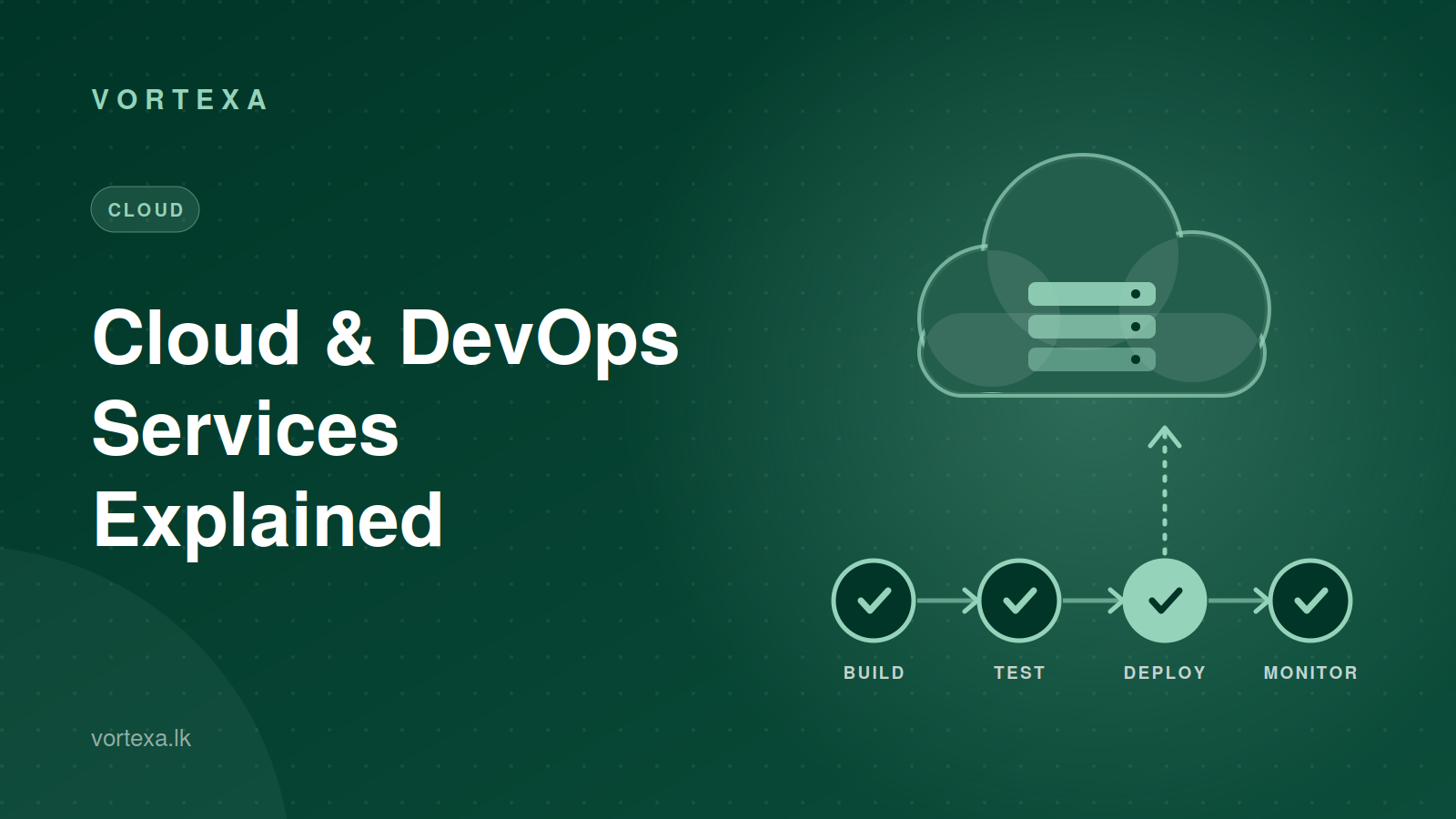
Cloud and DevOps services help software teams release changes faster, with fewer outages, on infrastructure that scales with demand. Cloud provides the computing resources; DevOps is the set of practices and automation that builds, tests, deploys, and monitors your software reliably. Together they replace manual, error-prone releases with repeatable pipelines.
What cloud and DevOps services usually include
- CI/CD pipelines that automatically build, test, and deploy every change
- Infrastructure as Code (Terraform or similar) so environments are reproducible
- Containerization with Docker and, where justified, orchestration with Kubernetes
- Monitoring, logging, and alerting so problems are caught before customers notice
- Security basics: access control, secrets management, encryption, and vulnerability scanning
- Backups, disaster recovery, and cost optimization
Signs your team needs DevOps
- Deployments are manual, stressful, or limited to a few people
- Bugs appear in production that never appeared on a developer's machine
- Outages are discovered by customers instead of alerts
- Staging and production behave differently
- Your cloud bill keeps growing and nobody can explain why
What to set up first
You don't need everything at once. A sensible order for most growing teams is:
- Version control with protected main branches and pull request reviews
- A CI pipeline that runs automated tests on every pull request
- Automated deployments to a staging environment, then production
- Infrastructure as Code for all environments
- Monitoring, logs, and alerts on the metrics that matter to users
- Backups with a tested restore process
Do you need Kubernetes?
Not always. Kubernetes is powerful but adds operational complexity. For many products, managed container services such as Google Cloud Run or AWS ECS give you scaling and zero-downtime deploys with far less overhead. Consider Kubernetes when you run many services, need fine-grained scheduling, or have a team that can operate it.
Controlling cloud costs
- Right-size instances based on actual usage, not guesses
- Use autoscaling and shut down idle non-production environments
- Set budgets and alerts so spikes are visible early
- Tag resources by team or product to see where money goes
- Review commitments and reserved capacity once usage is stable
Choosing AWS, GCP, or Azure
Pricing converges at scale, so choose based on your team's experience, the managed services you need, and any client compliance requirements. Our tech stack guide for SaaS products covers this decision in more detail.
Migrating existing systems
If you're moving legacy workloads, follow a phased approach: assess, plan, migrate non-critical systems first, and keep a rollback plan. Our cloud migration checklist walks through each phase.
Getting help
A good DevOps partner starts by auditing how you ship software today, then automates the highest-friction steps first. VORTEXA provides cloud and DevOps services including CI/CD, infrastructure as code, and cloud cost reviews. If you'd like an assessment, get in touch.
Frequently asked questions
What is DevOps in simple terms?
DevOps is a way of working where development and operations share responsibility for building, releasing, and running software. In practice it means automating builds, tests, deployments, and monitoring so changes ship quickly and safely.
What is the difference between cloud services and DevOps?
Cloud services provide the infrastructure, such as servers, databases, and storage, on demand. DevOps is the set of practices and tooling that lets you deploy and operate software on that infrastructure reliably. Most teams need both.
Do small teams need Kubernetes?
Usually not at first. Managed container platforms such as Cloud Run or AWS ECS often cover small and mid-size products with less complexity. Adopt Kubernetes when you run many services or need advanced orchestration and have the skills to operate it.
What does a CI/CD pipeline do?
A CI/CD pipeline automatically builds your code, runs tests, and deploys it when checks pass. This catches errors early, reduces manual steps, and lets teams release smaller changes more often with less risk.
How can I reduce my cloud bill?
Right-size resources to real usage, enable autoscaling, shut down idle environments, set budgets and alerts, and tag resources to see where spend comes from. A periodic cost review usually finds quick savings.
Related services
Cloud Systems
Resilient, cloud-native infrastructure and automated DevOps workflows built for 99.99% uptime, elastic scaling, and total peace of mind.
Custom Software
Bespoke, enterprise-grade software platforms engineered for scale, security, and long-term reliability — from internal tools to consumer-facing products.
API Ecosystems
Rock-solid, secure API layers that power seamless third-party integrations, mobile apps, and internal microservices — built to handle billions of calls.
Planning a project like this?
Tell us what you're building and we'll come back with a clear scope and next steps.